



Product Specifications: Acetate-based De-icers for Airport Runways
Winter maintenance of airport runway, taxiway and apron demands consideration of not only the rate of ice melting but also the duration of anti-icing, pavement friction characteristics, facility corrosion, environmental effect and operating windows. Due to the differences in the effective temperature ranges, administration techniques and dose rates of the products, real operating plans should take into account local minimum temperatures, snow kinds, and airport operational needs.
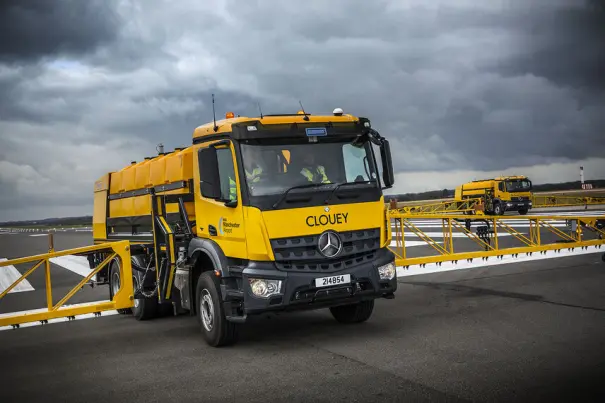
1. Solid potassium acetate (industrial grade, minimum 99%)
Main uses: Preventive distribution on airport runways and taxiways, de-icing of surfaces covered with ice. It lowers the freezing point and helps to restore the surface friction.
Product Features. Chloride free. The danger of corrosion of metal and concrete is usually less than with conventional chloride deicers. The solid product is easy for transport and mechanical spreading. Performance at low temperatures should be established based on product test results.
Apply 30-50 g/m² for preventive use before snowfall, and 50-120 g/m² for ice-covered surfaces. Application rates should be adjusted based on ice thickness, air temperature, pavement quality, and airport operating procedures, especially runway landing zones.
Note: The product is quite hygroscopic; keep in a sealed dry environment. Overapplication increases the pavement cleaning burden and increases material prices.
2. Liquid Potassium Acetate (Industrial Grade, 50%–60%)
Primary Use: Excellent for preventative de-icing and for fast application between flights. Can be applied to the pavement to provide a liquid coating to decrease ice and snow adhesion.
Product Features The liquid is used immediately by specialised airport spraying equipment, enabling generally uniform covering. Test reports and airport access criteria should include crystallisation temperature, runway surface friction, and environmental variables.
Pre-snowfall 20–40 g/m2, 40–80 emergency de-icing. Application rates and timing should be based on weather predictions, road surface temperatures and site observations.
Warning: Low temperatures may increase the viscosity of liquids. Tanks, pumps and spray lines should be insulated. Keep moisture and contaminants out after opening or pouring liquid.
3. Liquid potassium formate, industrial grade, minimum 75%
Main use: It is suitable for de-icing and anti-icing of runways, taxiways and associated infrastructure at airports in high-latitude or severely cold areas at low temperature.
Product Features: Potassium formate solutions may be formed into products with low freezing points, which have high fluidity and permeability. Specific minimum operating temperatures, holding periods and corrosion properties should be specified using third party test data and formulation concentration.
Recommended use: In very cold temperatures the substance may be sprayed undiluted. Recommended application rates are 30-50 g/m2 for preventative treatment and 60-100 g/m2 for emergency de-icing. It may also be used in conjunction with potassium acetate depending on test findings.
Note: The procurement costs are normally greater than for potassium acetate and the product is more suitable to applications where low temperature performance is required. It should be kept in a sealed container to avoid absorption of moisture or dilution by rain or snow.
4. Environmentally Friendly, Chloride-Free Snow-Melting Agent
Major uses Suitable for use on runways, taxiways, aprons and roadways around the airport. When choosing the product, confirm it is appropriate for either airside (flight area) or landside (non-flight area) zones.
Product Features Chloride-free formulation decreases the danger of corrosion to metal and concrete from chloride salts. Different models differ in freezing point, rate of melting of ice, biodegradability and compatibility with materials.
Suggested use The recommended dose is 40 to 100 g/m 2 , and it may be used by mechanical spreading or liquid spraying. Compatibility of this product with potassium acetate or potassium formate should be confirmed by means of material compatibility and performance testing on site.
Precautions: Choose product grade according to local minimum temperatures and airport specifications; observe effects on materials of aircraft, navigational aids and on concrete surfaces. Do not combine de-icing chemicals until compatibility has been verified.
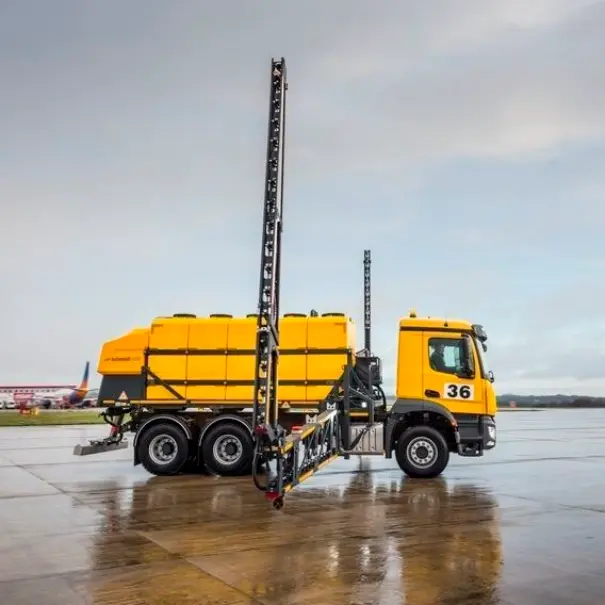
Project Application Case Studies
At one international airport, where severe winter temperatures might drop to -45°C, the use of conventional chloride-based de-icing solutions resulted in a heavy maintenance load because of the corrosion of airfield pavements and metal infrastructure. The airport changed to a blended product of 75% liquid potassium formate and 60% liquid potassium acetate, changing the percentage of mix and treatment rate according on weather and pavement conditions. According to the project record, the application can be carried out during the interval between flights, the pavement friction met the operating standards, and the infrastructure corrosion was greatly reduced, so the overall operation and maintenance cost per year was reduced by about 35% compared with the previous method. The findings are particular for the environment, equipment, operating processes and procurement costs of the airport and cannot be directly generalised to other projects.

USER EVALUATE
Here is the customer's evaluation of us