



How to Optimize Liquid Potassium Acetate for Highway Ice Prevention?
Optimizing liquid potassium acetate for highway ice prevention starts with selecting the right concentration, applying it at the correct rate, and timing the application before a storm event. As a non-chloride, biodegradable anti-icing agent, deicing liquid potassium acetate (CAS No. 127-08-2, CH₃COOK) works by depressing the freezing point of water down to -60°C, preventing ice from bonding to pavement surfaces. When applied properly through calibrated spray equipment, it protects road infrastructure, reduces long-term maintenance costs, and meets modern environmental compliance standards — making it a strong choice for highway maintenance professionals across the United States.
Understanding Liquid Potassium Acetate and Its Role in Highway Deicing
People who take care of the roads are looking for options to rock salt that are better for the environment and cause less corrosion. Potassium acetate solution is not a new idea, but it is slowly becoming more common. You can use it better if you know how it works chemically.
Chemical Properties That Make It Work
The chemical weight of liquid potassium acetate is 98.14, and it is a clear, colorless liquid that has a sour smell. It freezes at as low as -60°C (-76°F) when it is 50–60% concentrated. In other words, it can be used when it's very cold, and sodium chloride wouldn't work. The solution has a specific gravity of 1.25 to 1.30, which means it can get under layers of packed snow and ice and break the link with the sidewalk surface so it can be taken off by machine.
Hygroscopic Nature and Anti-Icing Behavior
Because it soaks up water from the area around it, it keeps the sidewalk wet with a cover of salt. Without this layer of salt, there would be no ice. This process is called de-icing. K+ acetate brine stops freezing rain or snow before it can stick when it is used before a storm. This means that overall, less product is needed than when it is used for reaction deicing after the ice has formed.
Environmental Compatibility
Instead of dangerous nitrogen chemicals, potassium acetate breaks down quickly in nature, unlike chloride-based deicers. There is a lot less biological oxygen demand (BOD) in it than in products made from urea. This means it follows the EPA's rules for releasing rainwater and can be used near places that need to be careful with water, like drains and bridge runoff zones.
Overcoming Limitations of Traditional Highway Deicing Methods
Road teams all over the US have used sodium chloride and calcium chloride for a long time. Engineers and purchasing managers are becoming less willing to pay the real costs that come with both goods, even though they do their jobs.
Infrastructure Damage from Chloride Salts
Steel rebar inside concrete bridge decks rusts faster when sodium chloride is present. This makes the concrete crack and the structure become weaker. A 2019 FHWA study says that road salts cause more than $5 billion in damage to U.S. infrastructure every year. Calcium chloride does its job better when it's cold, but it still gives off chloride ions that hurt metal parts in cars and drains. These long-term repair costs make it very hard to pay for highway maintenance.
Environmental Runoff Concerns
High-chloride runoff gets into both groundwater and surface water, which is bad for ecosystems that live in water. Chloride levels are being lowered in some U.S. states, and road salt has been named a pollution of worry by the Pollution Control Agency in Minnesota. Because of new rules, highway agencies are switching to deicing agents that don't have chloride in them. There is a direct link between this change and deicing liquid potassium acetate.
Why Acetate-Based Products Offer a Practical Alternative
Other deicers that are based on acetate, like potassium acetate, break down into potassium ions and acetate ions. Both of these substances are found in nature and are broken down by bugs in the dirt. That item doesn't leave any chemical waste on the ground or on the road next to it. A number of North American bridge officials have already moved their fixed automated spray technology (FAST) systems to fluids based on potassium acetate. They say this is because it saves money over time and means fewer corrosion checks.
Best Practices for Optimizing Application of Liquid Potassium Acetate on Highways
You should be careful about when you use potassium acetate brine, how you store it, and how well your tools are set up to get the most out of it. When highway teams use apps, these are the most important rules they should follow:
- Apply before the storm, not after. Anti-icing application 30–60 minutes before precipitation begins reduces ice adhesion and lowers overall product consumption by up to 75% compared to reactive deicing. The brine layer formed on dry pavement is thin but highly effective.
- Calibrate spray equipment for the correct coverage rate. Standard coverage for liquid potassium acetate anti-icing runs between 20–40 gallons per lane-mile, depending on temperature and forecast precipitation type. Tanker spray booms and calibrated nozzle systems ensure even distribution across the full lane width.
- Maintain product concentration at 50–60% w/w. Dilution below 45% concentration raises the freezing point significantly, reducing effectiveness at temperatures below -20°C. Use a refractometer on-site to verify concentration before loading trucks.
It's also important to put things away the right way. To make sure SHANXI ZHAOYI's deicing liquid potassium acetate stays safe, it should be stored in HDPE or stainless steel (304/316) containers that are kept dry and away from heat and moisture. In sealed containers that are compatible with the product, it can be kept for an infinite amount of time. But after two years of storage, the concentration and pH (should be between 7.5 and 9.2) should be checked again every year.
When highway crews use these techniques, they can get consistent, measured performance from every application, reduce waste, and follow environmental rules.
Comparing Liquid Potassium Acetate with Other Deicing Solutions for Highway Use
Most of the time, procurement managers compare more than one deicing product before choosing one for the season. In the table below, you can see how potassium acetate compares to other common road chemicals in the most important ways.
Performance at Low Temperatures
Deicing liquid potassium acetate(CAS NO.: 127-08-2) works down to -60°C at full strength. It is better than sodium chloride, which only works down to about -9°C, and similar to or better than calcium chloride, which only works down to about -29°C. When it gets below -20°C for several days at a time in the northern states, this temperature range is important for highways.
Infrastructure and Material Compatibility
Airports like urea, but it breaks down into ammonia, which is bad for marine life and makes sewage systems have a lot of BOD. It is easier to find magnesium acetate in big liquid form, but it costs more and breaks down more slowly. To break down sodium acetate that is rigid, you will need extra tools. Lime-based potassium acetate is ready to use and doesn't need to be mixed on-site. It doesn't need to be changed to work with FAST bridge systems or tanker spray equipment.
Total Cost of Ownership
Even though potassium acetate costs more per gallon than sodium chloride, it's about the same in terms of how much it saves you on compliance, infrastructure repairs, and the number of times it needs to be used in anti-icing mode. When the FHWA talks about cost-benefit analyzes of curb preservation treatments, they always say that using acetate-based products for strategic deicing saves money in the long run on fixing and replacing concrete and rebar.
Procurement and Supply Considerations for Liquid Potassium Acetate
Sourcing liquid potassium acetate reliably at scale requires more than finding the lowest price. Quality consistency, certifications, and supply continuity are the factors that determine whether a procurement decision holds up over an entire winter season.
Verifying Product Quality and Certifications
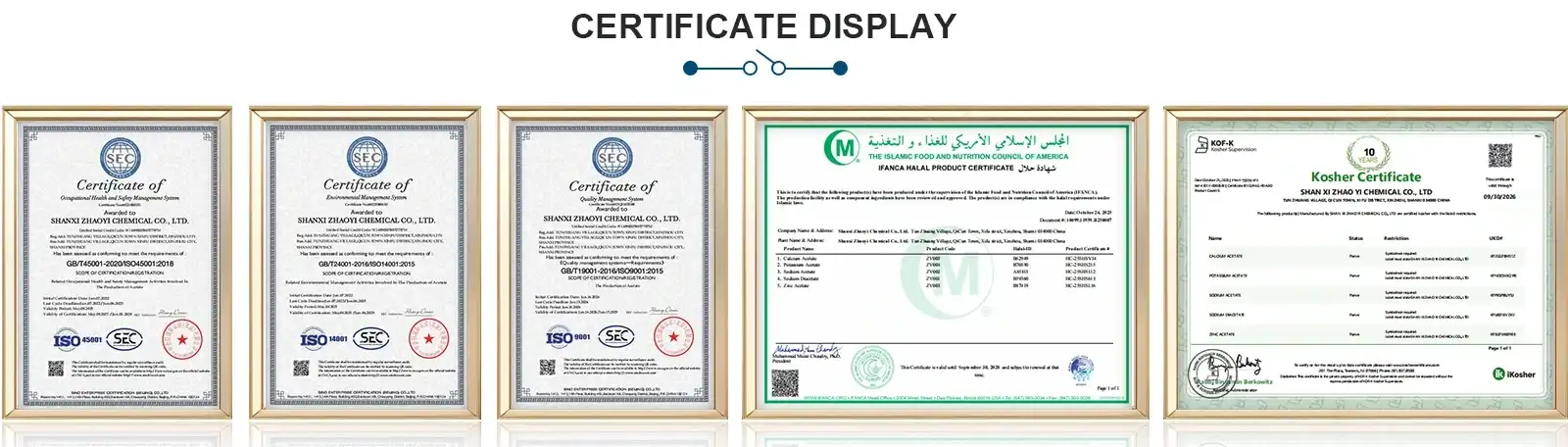
Procurement specifications for highway deicers should require a Certificate of Analysis (CoA) confirming CH₃COOK content at ≥50–60%, chloride content ≤0.01%, heavy metals (Pb) ≤0.01%, and pH within 7.5–9.2. SHANXI ZHAOYI CHEMICAL holds ISO 9001, ISO 14001, and ISO 45001 certifications, and the company's production facility operates with an annual capacity of 150,000 tons of acetate products. Founded in 1988, the company has supplied acetate series products to customers across North America, Europe, and Asia.
Packaging and Logistics for Bulk Orders
The product ships in 1,000L IBC tanks or flexibags for container shipping, making it practical for large municipal contracts or highway contractor fleets. Standard production lead times run 5–7 working days, with 24-hour delivery arrangements available for in-stock inventory. The company supports FOB, CIF, and DAP trade terms, allowing U.S. buyers to structure contracts that match their logistics infrastructure.
Building a Reliable Supply Chain
Procurement teams handling winter maintenance contracts should place orders before October to secure adequate inventory ahead of peak demand. Working directly with a manufacturer rather than a multi-tier distributor reduces lead time uncertainty and gives procurement officers direct access to technical documentation, batch traceability records, and product adjustment options for specialized applications.
Conclusion
To keep the roads from freezing over, deicing liquid potassium acetate(CAS NO.: 127-08-2) is a good choice that is also good for the environment. In cold weather, it works better than chloride salts. It also keeps things from rusting and breaks down naturally without leaving behind any dangerous chemicals. To get the best results, you should use it regularly, handle the concentration correctly, and buy it from a business that has quality control checks in place. When it comes to deicing, potassium acetate is a great choice if you work in shopping or highway repair and want a reliable product that makes driving safer in the winter without the hidden costs of chloride damage.
FAQ
What concentration of liquid potassium acetate works best for highway anti-icing?
A concentration of 50–60% w/w provides the best balance of freezing point depression and application efficiency. At this concentration, the freezing point reaches -60°C. Dilution below 45% noticeably reduces performance at temperatures below -20°C.
Is potassium acetate safe for use near waterways?
Yes. Potassium acetate biodegrades rapidly through natural microbial activity and carries a low BOD load, making it significantly safer for aquatic environments than chloride salts or urea-based deicers.
Can it be used in FAST bridge spray systems?
Potassium acetate liquid integrates directly with Fixed Automated Spray Technology systems due to its stable liquid form and non-clogging properties. Many North American bridge authorities have already adopted it for automated bridge deck anti-icing.
How should liquid potassium acetate be stored on-site?
Store it in sealed HDPE or stainless steel containers in a dry, ventilated warehouse away from heat and incompatible substances. Verify concentration and pH annually if stored beyond two years.
What is the minimum effective temperature for active deicing?
While the freezing point is -60°C, practical active deicing effectiveness typically ranges from -29°C to -35°C depending on dilution and precipitation intensity.
Partner With SHANXI ZHAOYI CHEMICAL for Your Deicing Needs
The company SHANXI ZHAOYI CHEMICAL has been making acetate goods since 1988. Each shipment has ISO 9001, ISO 14001, and ISO 45001 certifications. Every year, they can make up to 150,000 tons of them. We provide our product in 1,000L IBC drums and flexibags as a bulk liquid, as a dependable manufacturer of deicing liquid potassium acetate. Our goods are always of the same high quality, and we can trace each batch back to where it came from. Email our tech team at sxzy@sxzhaoyi.com or go to sxzhaoyi.com right now to get a sample, a COA, or a bulk price for your upcoming winter maintenance season.
References
1. Federal Highway Administration (FHWA). Manual of Practice for an Effective Anti-Icing Program. U.S. Department of Transportation, 1996.
2. Minnesota Pollution Control Agency. Chloride in Minnesota Waters: Sources, Impacts, and Management. 2013.
3. Transportation Research Board. Snow and Ice Control: Materials, Equipment, and Management Strategies. National Academies Press, 2007.
4. Fischel, M. Evaluation of Selected Deicers Based on a Review of the Literature. Colorado Department of Transportation, 2001.
5. Shi, X., Veneziano, D., Xie, N., & Gong, J. Use of Chloride-Based Ice Control Products for Sustainable Winter Road Maintenance. Cold Regions Science and Technology, 2013.
6. SAE International. Aerospace Material Specification AMS 1435: Fluid, Generic, Deicing/Anti-Icing Runways and Taxiways. SAE International, 2012.

USER EVALUATE
Here is the customer's evaluation of us